One of the world's largest remittance-sending markets and a regional hub for cross-border payments, digital banking and fintech innovation in the Gulf.
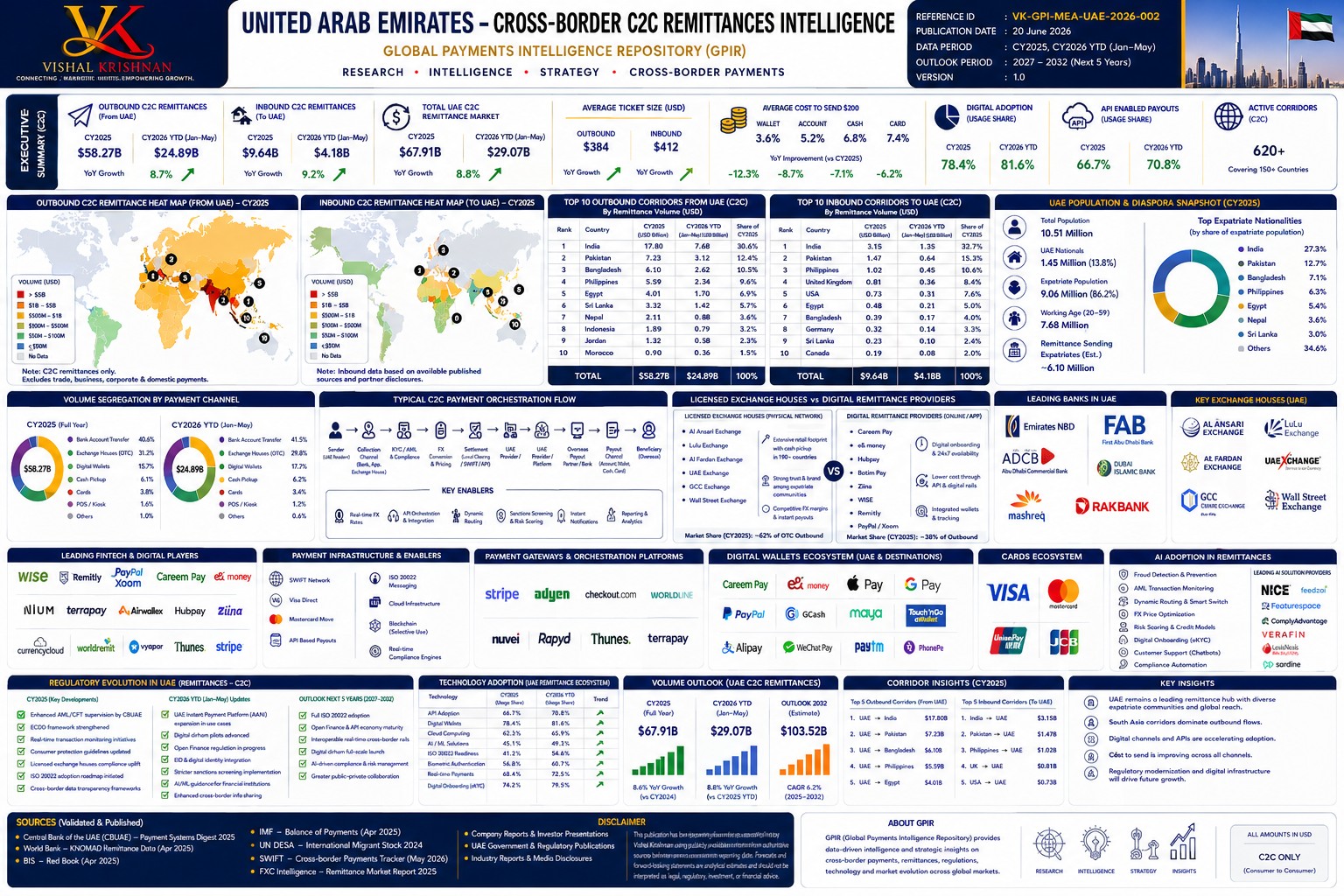
The United Arab Emirates is one of the world's most significant remittance-sending markets and a regional hub for cross-border payments, digital banking and fintech innovation in the Gulf Cooperation Council (GCC). Its economy is closely tied to a large expatriate workforce, whose outbound remittances flow primarily to South Asia, Southeast Asia and Africa through a mix of licensed exchange houses, bank transfers and, increasingly, instant payment rails.
The UAE has invested heavily in modernising its domestic payments infrastructure over the past decade, moving from legacy batch-based systems toward real-time rails, open finance initiatives and an active central bank digital currency (CBDC) programme.
Expatriates make up the overwhelming majority of the UAE's resident population, making migration and diaspora composition a structural driver of the country's cross-border P2P and remittance flows rather than a peripheral demographic fact. The figures below reuse the "UAE Population & Diaspora Snapshot" panel already published on the GPIR UAE dashboard — sourced to UN DESA's International Migrant Stock and UAE Government & Regulatory Publications — rather than introducing a second, disconnected dataset.
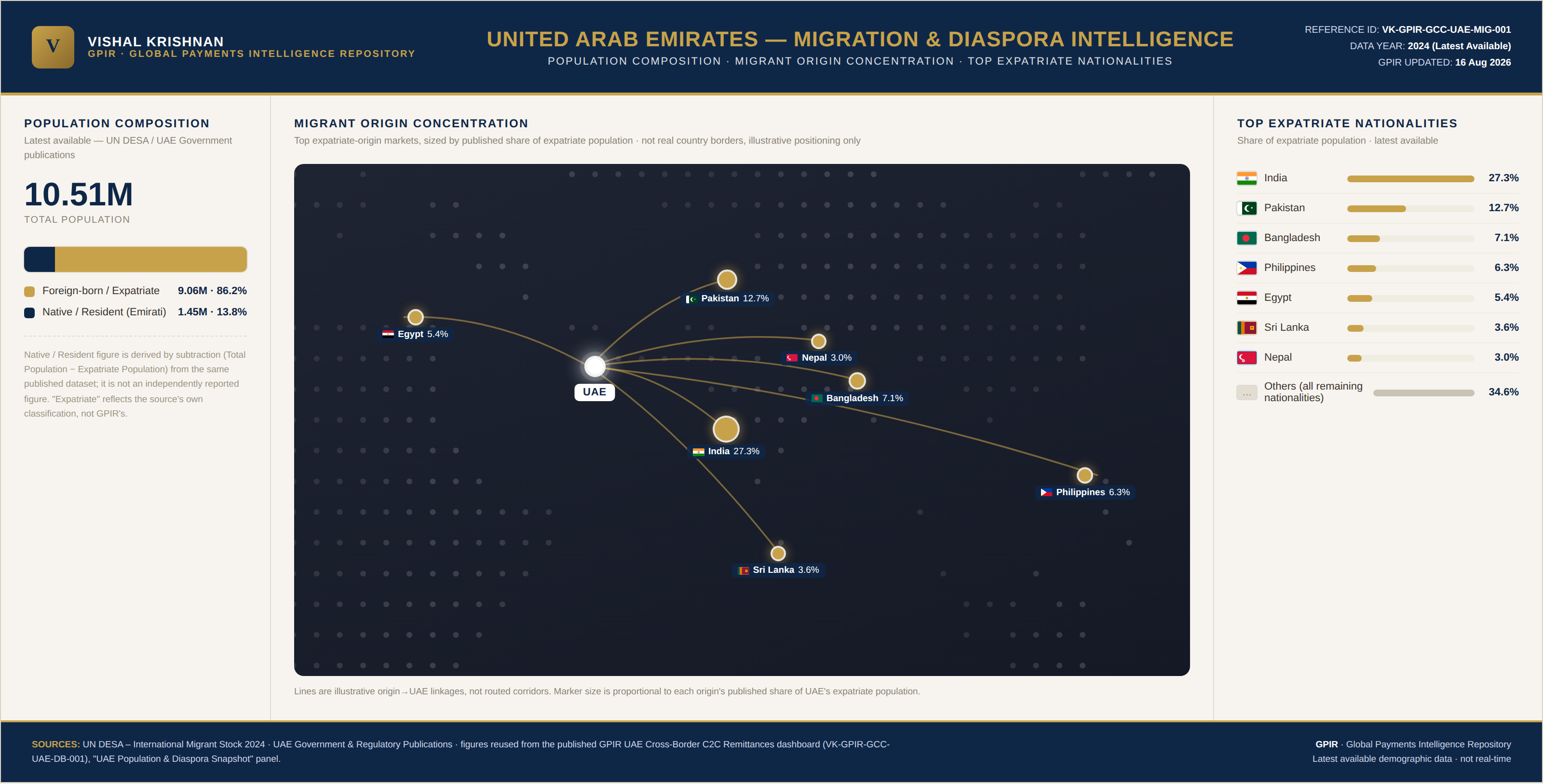
These same origin markets anchor the outbound remittance corridors covered under Payment Rails & Infrastructure below and in the dashboard's own corridor tables — the two are the same underlying population, not separate figures.
The national currency is the UAE Dirham (AED), which has historically been pegged to the US Dollar at a fixed rate of approximately AED 3.6725 per USD. This peg underpins exchange-rate stability for trade and remittance flows moving through the country.
Key domestic payment infrastructure operated under the Central Bank of the UAE (CBUAE) includes:
Cross-border remittance flows are additionally routed through licensed exchange houses and money-transfer operators alongside bank-led corridors.
The banking sector combines large domestically headquartered banks — including Emirates NBD, First Abu Dhabi Bank (FAB) and Abu Dhabi Commercial Bank (ADCB) — with a significant presence of international banks. Two financial free zones operate under their own independent regulatory regimes: the Dubai International Financial Centre (DIFC), regulated by the Dubai Financial Services Authority (DFSA), and Abu Dhabi Global Market (ADGM), regulated by the Financial Services Regulatory Authority (FSRA).
The Central Bank of the UAE (CBUAE) is the primary regulator for banking, payments and money-services businesses at the federal level, operating alongside the DFSA and FSRA within the two financial free zones. Retail payment services and card schemes are governed under CBUAE's Retail Payment Services and Card Schemes Regulation, with an AML/CFT framework aligned to FATF standards.
Dubai and Abu Dhabi have positioned themselves as regional fintech and digital-assets hubs, supported by free-zone regulatory sandboxes (including DIFC's innovation licensing and ADGM's RegLab). The CBUAE has an active Digital Dirham CBDC strategy spanning wholesale and retail use cases, alongside broader open-finance initiatives aimed at expanding API-based data and payment access across licensed institutions.
This page is a draft scaffold pending formal sourcing and citation against CBUAE publications, DFSA/FSRA regulatory texts and other primary references. It should be treated as directional only until verified.