Home to UPI, one of the world's largest real-time retail payment systems by volume, and one of the largest inbound remittance markets globally.
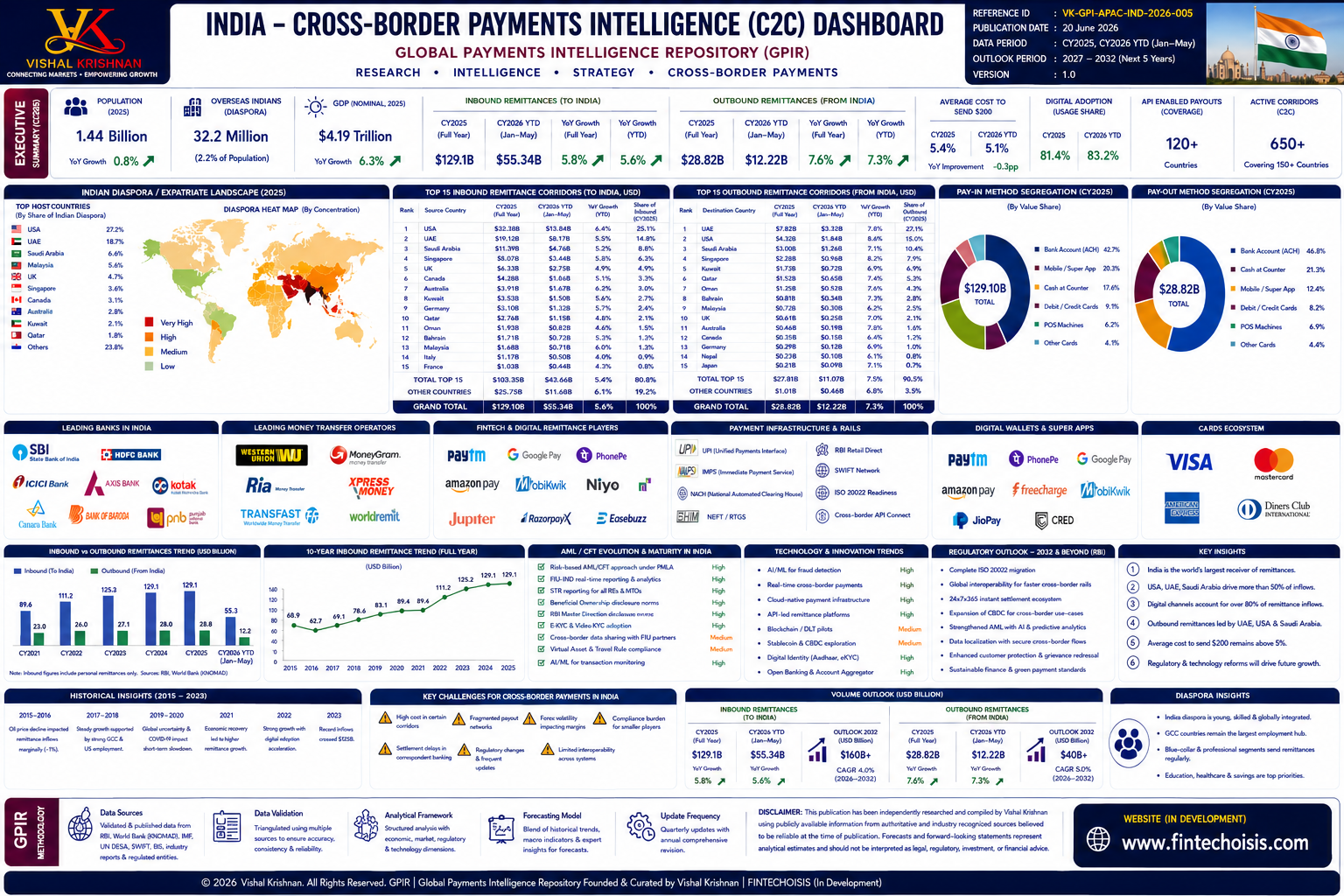
India is home to the Unified Payments Interface (UPI), one of the largest real-time retail payment systems in the world by transaction volume, and is consistently among the largest recipients of inbound personal remittances globally. Its payments ecosystem has been reshaped over the past decade by a state-backed digital public infrastructure strategy spanning identity, payments and data layers.
India has the largest diaspora population in the world. GPIR's own Country Intelligence Dashboard (embedded above; Reference ID VK-GPI-APAC-IND-2026-005, published 20 June 2026) puts Overseas Indians at 32.2 million for 2025 (2.2% of population), and includes a Diaspora Heat Map showing geographic concentration by destination country. Independently, the UN Department of Economic and Social Affairs (UN DESA) International Migrant Stock 2024 puts India-born people living outside India at approximately 18.5 million — still the highest of any origin country globally, on a stricter birth-country-only basis. India's Ministry of External Affairs (MEA) separately tracks Non-Resident Indians (NRIs) plus Persons of Indian Origin (PIOs) at 34.36 million across 208 countries and territories as of January 2025.
These three figures are not directly comparable: UN DESA counts India-born residents abroad from census/register data; MEA additionally includes foreign-citizen Persons of Indian Origin; GPIR's dashboard figure sits between the two and reflects the dashboard's own compiled methodology (see Sources below). GPIR reports all three rather than picking one, and none should be treated as a projection or correction of the others.
Top diaspora destinations (GPIR Dashboard, by share of Indian diaspora, 2025): USA 27.2%, UAE 18.7%, Saudi Arabia 6.6%, Malaysia 5.6%, UK 4.7%, Singapore 3.1%, Canada 3.1%, Australia 2.8%, Kuwait 2.1%, Qatar 1.8%, all other countries combined 23.8%. The full heat map (Very High / High / Medium / Low concentration by country) is in the embedded dashboard above — GPIR has not yet rebuilt it as an interactive on-page map, so the image is the authoritative version until that work is scheduled.
Methodology note: the GPIR dashboard states its diaspora and remittance figures are compiled from RBI, World Bank (KNOMAD), IMF, UN DESA, SWIFT and BIS data, cross-checked against industry reports; forward-looking figures are analytical estimates, not verified actuals. Treat the dashboard's compiled figure (32.2M) as directionally consistent with, not a replacement for, the two independently issued government/UN figures above.
The national currency is the Indian Rupee (INR). The Reserve Bank of India (RBI) manages the currency under a managed-float exchange rate regime, intervening periodically to limit excess volatility rather than defending a fixed peg.
Core domestic payment rails, largely operated or overseen by the National Payments Corporation of India (NPCI) under RBI's regulatory umbrella, include:
The sector includes public-sector banks, private banks, small finance banks and payments banks, all regulated by the RBI. NPCI operates as the central retail payments infrastructure utility, running UPI, IMPS, RuPay (the domestic card network) and related settlement rails on behalf of participating banks.
No central bank or agency publishes a strict P2P-app-only split of cross-border transfer volume separate from wider consumer remittances. The closest validated proxy GPIR has is its own C2C (consumer-to-consumer) cross-border dashboard for India (embedded above), compiled from RBI, World Bank/KNOMAD, IMF, UN DESA, SWIFT and BIS data. The figures below are that dashboard's inbound/outbound remittance data, which is consumer-to-consumer in nature but not verified to exclude every non-P2P consumer transfer — read it as "C2C remittances," GPIR's nearest sourced approximation of P2P, not as a certified P2P-only figure.
| Metric | CY2025 (Full Year) | CY2026 YTD (Jan–May) |
|---|---|---|
| Inbound C2C remittances (to India) | $129.10B ▲ 5.8% YoY | $55.34B ▲ 5.6% YoY |
| Outbound C2C remittances (from India) | $28.82B ▲ 7.6% YoY | $12.22B ▲ 7.3% YoY |
| Average cost to send $200 | 5.4% | 5.1% |
| Digital / account-based adoption share | 81.4% | 83.2% |
| Number of transactions / avg. transaction value | Data Under Development | Data Under Development |
CY2026 YTD covers January–May only, per the source dashboard, and must not be read as a full-year estimate. "C2C remittances" is GPIR's nearest sourced proxy for P2P cross-border transfers, not a certified P2P-only figure — transaction counts and average ticket size remain Data Under Development pending a source that reports them.
GPIR's Country Intelligence Dashboard (above) tracks India's top 15 inbound and outbound C2C remittance corridors for CY2025 and CY2026 YTD (Jan–May). By CY2025 share of inbound volume, the leading corridors into India were USA (25.1%, $32.18B), UAE (14.8%, $19.12B), Saudi Arabia (10.4%, $11.39B), Singapore (6.3%, $8.07B) and UK (4.9%, $6.33B). By CY2025 share of outbound volume, the leading corridors from India were UAE (27.1%, $7.82B), USA (15.0%, $3.32B), Saudi Arabia (10.4%, $1.26B) and Singapore (6.9%, $0.96B). Full top-15 tables with CY2026 YTD and YoY growth are in the embedded dashboard image above.
This is consistent with GPIR's separately published corridor research (see the Major Corridors chapter), which classifies USA → India, UAE → India, Saudi Arabia → India and UK → India as Tier A strategic corridors, and South Asia (led by India) as the world's largest remittance-receiving region through 2040.
India has also built live infrastructure-level cross-border linkages rather than only informal remittance corridors: the UPI–PayNow real-time payment linkage with Singapore is operational (see the Wallets, Mobile Money & Super Apps chapter), alongside UPI acceptance arrangements in the UAE, France and other jurisdictions referenced in the Fintech & Digital Ecosystem section below. GPIR's dashboard separately reports 650+ active C2C corridors covering 150+ countries and API-enabled payout coverage of 120+ countries (2025) — these are dashboard-compiled counts, not independently re-verified by GPIR editorial.
The Reserve Bank of India regulates payment systems under the Payment and Settlement Systems Act, 2007, and issues periodic guidelines covering areas such as data localisation, digital lending and payment aggregator licensing. NPCI operates under RBI's oversight as a not-for-profit umbrella entity for retail payments.
India has actively pursued international expansion of UPI through bilateral linkages with several markets, including a UPI–PayNow linkage with Singapore, alongside acceptance arrangements in the UAE, France and other jurisdictions. The RBI has also run wholesale and retail pilots of a central bank digital currency, the e₹ (e-Rupee), since late 2022.
Data Under Development — a verified count of fintechs, PSPs and wallet operators active in India will be added once sourced against a primary registry rather than estimated.
Diaspora & migration. India's outbound diaspora is the largest in the world on every measure GPIR tracks: 32.2 million on GPIR's own compiled dashboard figure, 18.5 million by UN DESA's stricter birth-country migrant stock, and 34.36 million by MEA's broader NRI+PIO count. The USA and UAE alone account for roughly 46% of that diaspora by GPIR's dashboard breakdown. That scale is the structural reason India is consistently the world's largest remittance-receiving market: a large, geographically concentrated diaspora sustains inbound consumer transfer demand independent of any single corridor.
C2C / P2P payments. GPIR's C2C dashboard shows inbound remittances to India growing from $129.10B (CY2025) at a pace of +5.8% YoY, with CY2026 YTD (Jan–May) already at $55.34B (+5.6% YoY) — growth has been broadly stable rather than accelerating or decelerating sharply between the two periods. Outbound remittances are smaller in absolute terms ($28.82B CY2025) but growing faster (+7.6% YoY), consistent with rising outbound mobility and a growing resident non-citizen population. GPIR frames this as C2C, its nearest sourced proxy for P2P, because no source splits P2P specifically from wider consumer remittances.
Corridors & infrastructure. The USA and UAE dominate both inbound and outbound corridors, but from different bases: the USA leads inbound share (25.1%) reflecting the size and income profile of the US-based diaspora, while the UAE leads outbound share (27.1%) reflecting India's large resident/working population with UAE ties. This asymmetry — a wealthy, established diaspora sending home versus a large resident population sending to a nearby labour-migration hub — is a structural feature of India's corridor mix, not a one-off. Beyond corridor volumes, India has moved toward live infrastructure-level linkages, most notably UPI–PayNow with Singapore.
Regulatory & ecosystem. RBI and NPCI continue to expand UPI's footprint internationally and have run CBDC (e₹) pilots since 2022; this page's Regulatory Environment and Fintech & Digital Ecosystem sections above track that content, unchanged from GPIR's original scaffold pending formal verification. A verified fintech/PSP participant count remains the one meaningful gap in this page's "At a Glance" cards.
This commentary is written to be re-editable as the underlying dashboard (IND-2026-005) is refreshed, and as the outstanding fintech-count and transaction-level figures move from Data Under Development to sourced numbers — it should not be left describing figures that have since changed.
This page is a draft scaffold pending formal sourcing and citation against RBI and NPCI publications and other primary references for its Currency, Payment Rails, Banking, Regulatory and Fintech sections. It should be treated as directional only until verified.
The Country at a Glance, Diaspora & Migration Intelligence, P2P Cross-Border Payments and Corridor Intelligence sections above draw on the following, independently dated sources:
Transaction counts, average ticket size and a verified fintech/PSP participant count are marked Data Under Development above because GPIR has not identified a source that reports them at the granularity this page requires, and will not substitute an estimate for a verified figure.