A top-three global remittance-sending market and the largest economy in the GCC, undergoing rapid payments modernisation under Vision 2030 as flows shift from cash to real-time digital rails.
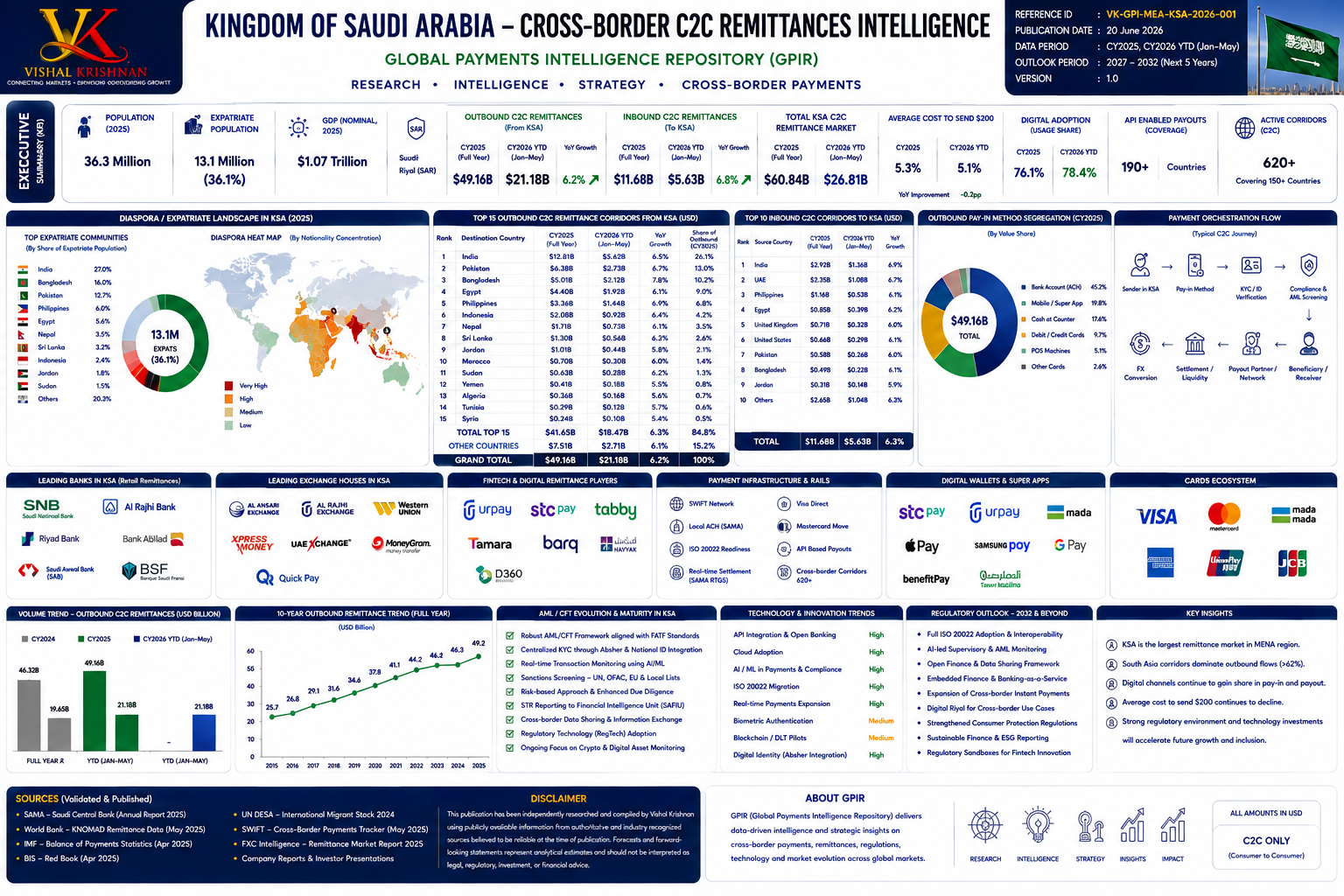
Saudi Arabia is the largest economy in the Gulf Cooperation Council and one of the world's top remittance-sending markets, with a large expatriate workforce concentrated in construction, services and skilled professional roles. Vision 2030 has driven aggressive fintech licensing and payments modernisation, with SAMA (the Saudi Central Bank) overseeing a shift from cash-based transfers toward licensed digital channels and real-time payment rails.
Cross-border remittance corridors are dominated by South Asia and the Middle East/North Africa region, routed through a mix of bank transfers, licensed exchange houses and an expanding set of SAMA-regulated digital remittance and fintech players.
Expatriates make up more than a third of Saudi Arabia's resident population, making migration and diaspora composition a structural driver of the country's cross-border P2P and remittance flows. The figures below reuse the "Diaspora / Expatriate Landscape in KSA" panel already published on the GPIR Saudi Arabia dashboard — sourced to SAMA, UN DESA's International Migrant Stock and World Bank KNOMAD — rather than introducing a second, disconnected dataset.
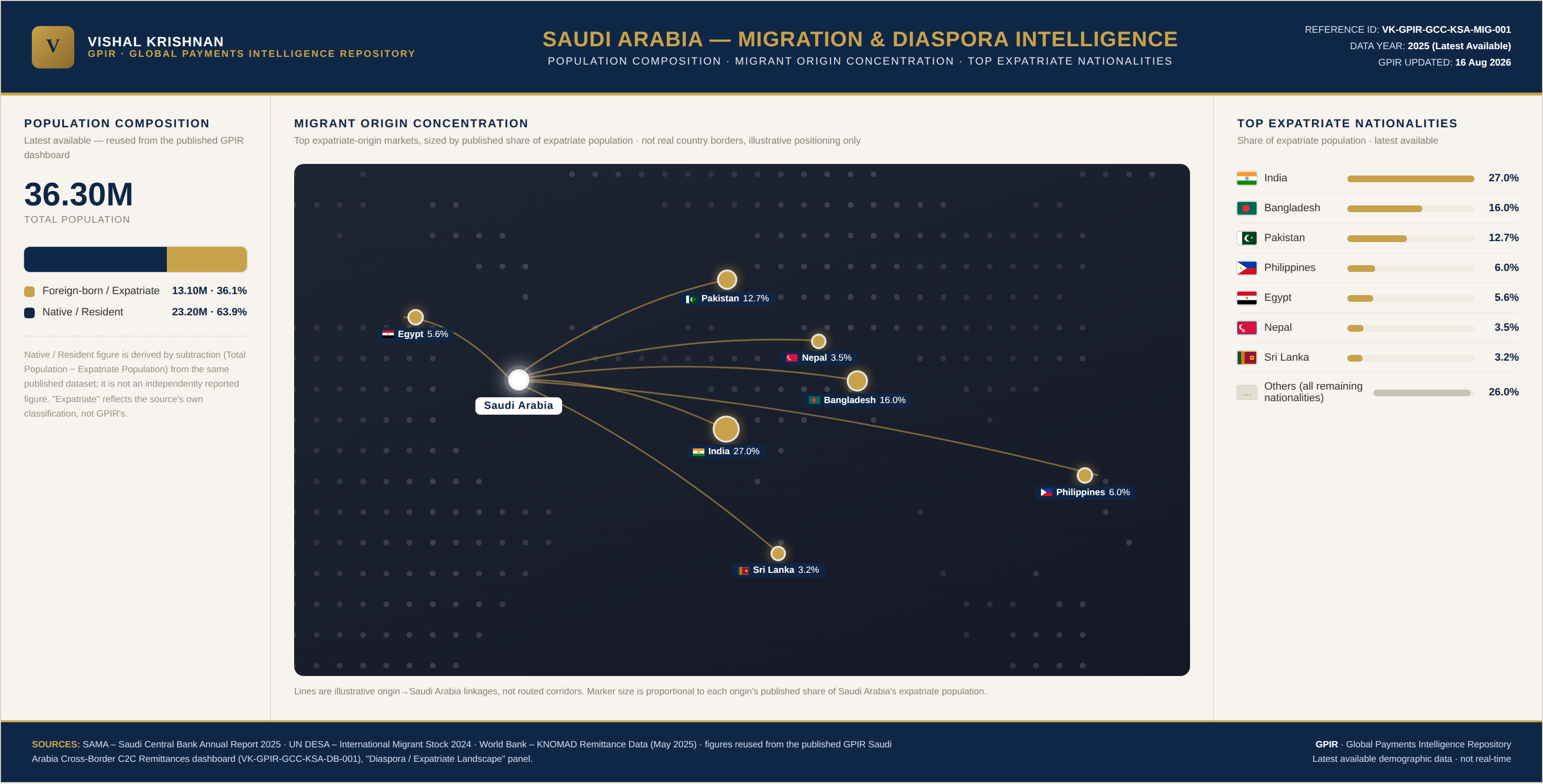
These same origin markets anchor the outbound remittance corridors covered under Payment Rails & Infrastructure below and in the dashboard's own corridor tables — the two are the same underlying population, not separate figures.
The national currency is the Saudi Riyal (SAR), pegged to the US Dollar at a fixed rate of approximately SAR 3.75 per USD since 1986, providing exchange-rate stability for trade and remittance flows moving through the country.
Key domestic payment infrastructure operated under SAMA (Saudi Central Bank) includes:
Cross-border remittance flows are additionally routed through a dense network of licensed exchange houses — including Al Rajhi Exchange, Al Ansari Exchange, Xpress Money and UAExchange — and bank-led corridors, alongside newer SAMA-licensed digital remittance and fintech providers.
The banking sector is anchored by large domestic institutions including Saudi National Bank (SNB, formed from the 2021 merger of National Commercial Bank and Samba), Al Rajhi Bank (one of the world's largest Islamic banks by assets), Riyad Bank, Bank AlBilad, Saudi Awwal Bank (SAB) and Banque Saudi Fransi (BSF). Islamic (Sharia-compliant) banking represents a substantial share of the sector alongside conventional banking.
SAMA (Saudi Central Bank) is the primary regulator for banking, payments, insurance and licensed fintech activity, operating an active regulatory sandbox and fintech licensing programme as part of the Financial Sector Development Program under Vision 2030. AML/CFT supervision is aligned with FATF standards, with real-time transaction monitoring and centralised KYC through Absher and National ID integration.
Saudi Arabia's fintech sector has expanded rapidly under SAMA's sandbox and licensing regime, with digital wallets and payment apps including urpay, stc pay, Tamara (buy-now-pay-later) and barq, alongside D360 and other digital-first providers. Digital wallet and mobile/super-app usage has grown as a share of retail payments, supported by SAMA's Open Finance and API integration initiatives.
This page is a draft scaffold pending formal sourcing and citation against SAMA publications and other primary references, with the exception of the Executive Snapshot and Migration & Diaspora Intelligence figures above, which are reused directly from the published GPIR Saudi Arabia dashboard (VK-GPIR-GCC-KSA-DB-001) and its cited sources. The remaining narrative sections should be treated as directional only until verified.