One of the highest expatriate-workforce shares in the world, sustaining dense remittance corridors to South Asia, Egypt and the Philippines via QCB's Fawran instant payments rail.
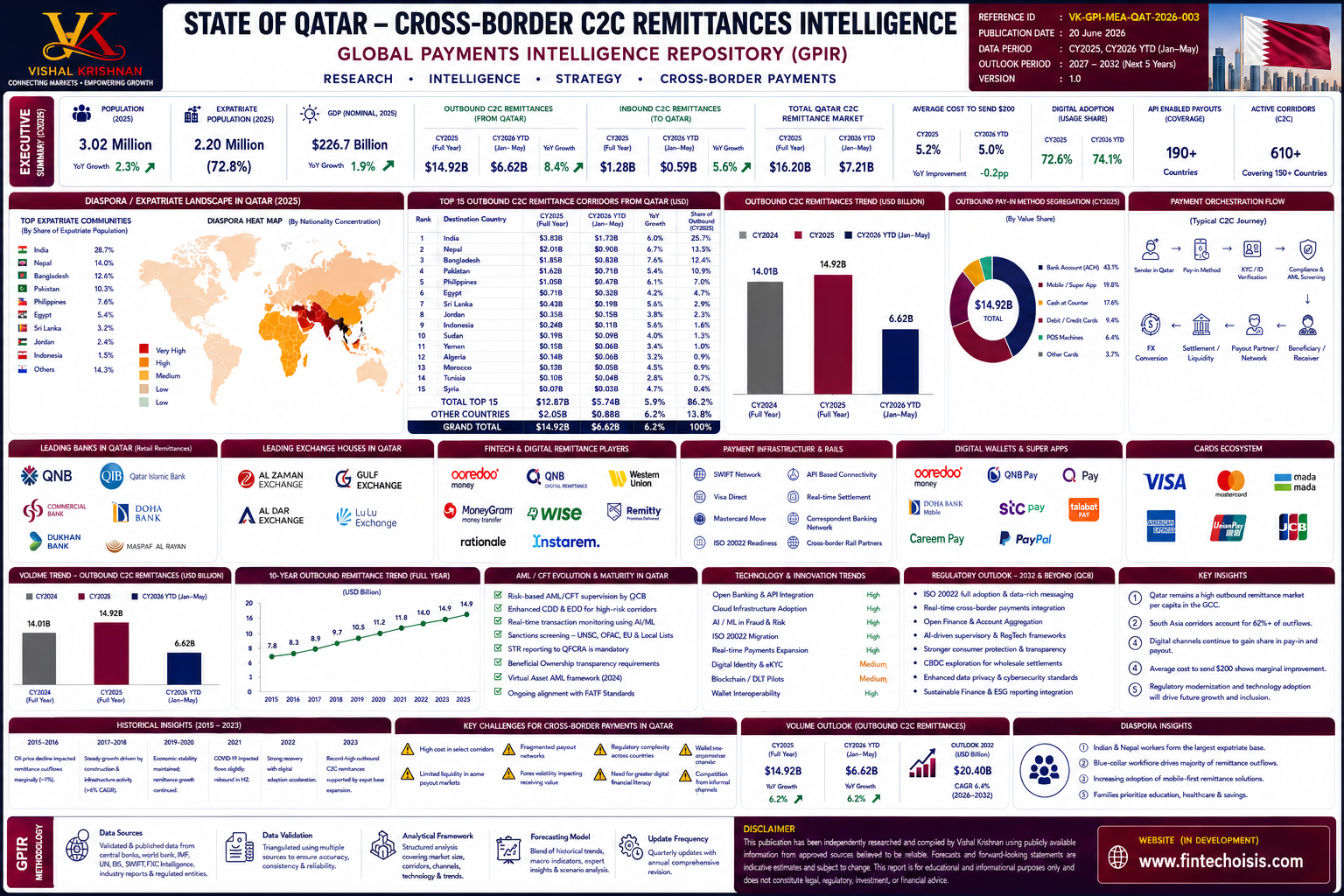
Qatar has one of the highest expatriate population shares of any country, with a workforce concentrated in construction, energy, hospitality and professional services. This demographic structure makes cross-border remittances a structurally significant share of the country's payment flows, dominated by corridors to South Asia (India, Nepal, Bangladesh, Pakistan), the Philippines and Egypt.
QCB (Qatar Central Bank) oversees a payments modernisation programme centred on the Fawran instant payments rail, alongside an active Open Banking and fintech licensing agenda.
Expatriates make up nearly three-quarters of Qatar's resident population — one of the highest shares of any country — making migration and diaspora composition central to the country's cross-border P2P and remittance flows. The figures below reuse the "Diaspora / Expatriate Landscape in Qatar" panel already published on the GPIR Qatar dashboard — sourced to UN DESA's International Migrant Stock and Qatar Central Bank / Government publications — rather than introducing a second, disconnected dataset.
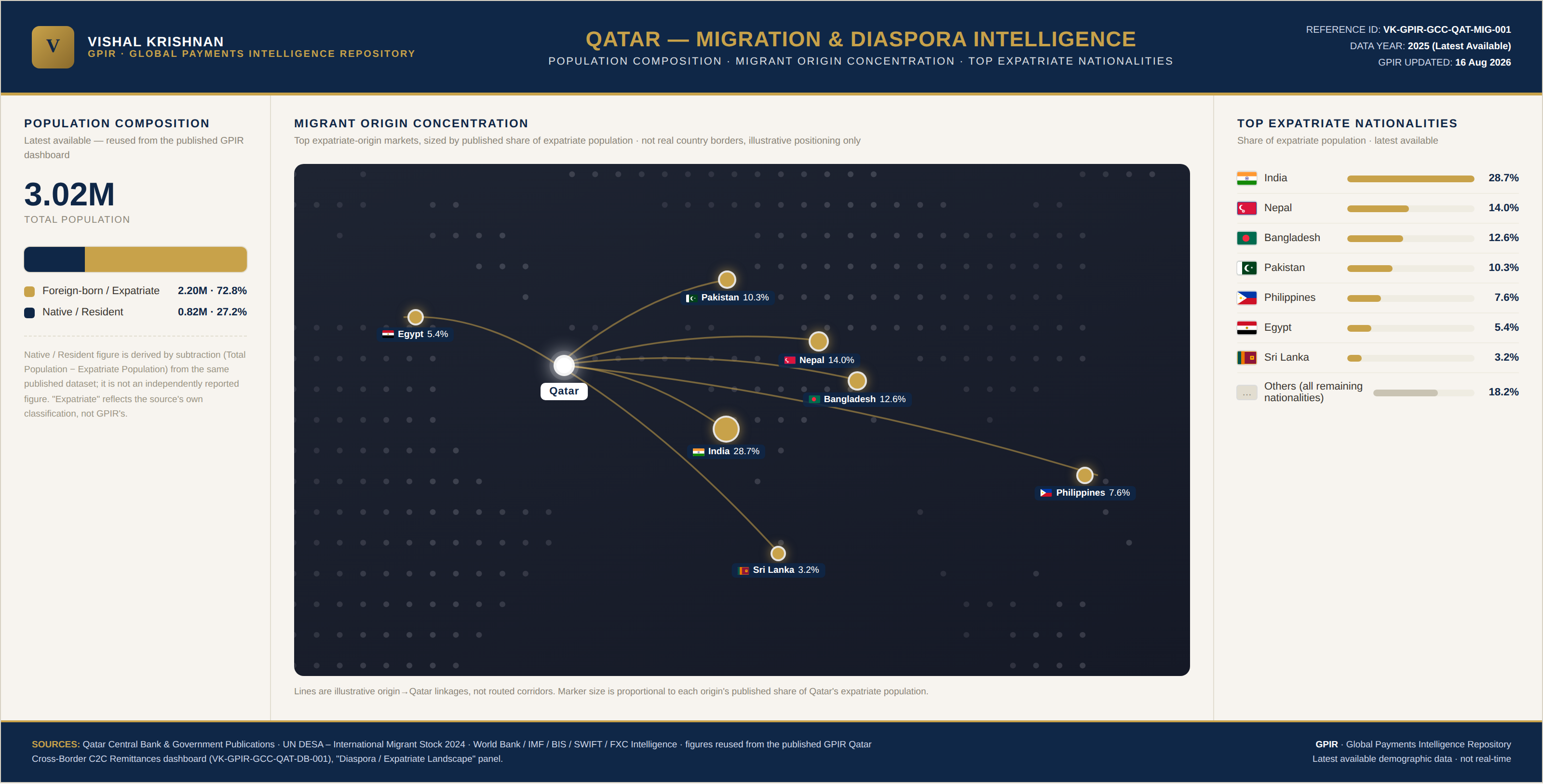
These same origin markets anchor the outbound remittance corridors covered under Payment Rails & Infrastructure below and in the dashboard's own corridor tables — the two are the same underlying population, not separate figures.
The national currency is the Qatari Riyal (QAR), pegged to the US Dollar at a fixed rate of approximately QAR 3.64 per USD, supporting exchange-rate stability for trade and remittance flows.
Key domestic payment infrastructure operated under QCB (Qatar Central Bank) includes:
Cross-border remittance flows are additionally routed through licensed exchange houses — including Al Zaman Exchange, Gulf Exchange, Al Dar Exchange and LuLu Exchange — and bank-led corridors.
The banking sector is anchored by Qatar National Bank (QNB, the GCC's largest bank by assets), alongside Qatar Islamic Bank, Commercial Bank of Qatar, Doha Bank, Dukhan Bank and Masraf Al Rayan. Islamic banking represents a significant and growing share of the sector.
QCB (Qatar Central Bank) is the primary regulator for banking, payments and licensed fintech activity, with the Qatar Financial Centre Regulatory Authority (QFCRA) separately regulating firms operating within the Qatar Financial Centre free zone. AML/CFT supervision is aligned with FATF standards, with mandatory suspicious-transaction reporting to the Qatar Financial Information Unit (QFIU).
Qatar's digital payments ecosystem includes Ooredoo Money and QNB's digital remittance offerings, alongside international MTOs (Western Union, MoneyGram, Wise, Instarem) operating under QCB licensing. Digital wallet and mobile-app usage has grown as a share of outbound remittances, supported by QCB's Open Banking and API-based payments initiatives building on the digital infrastructure expansion around the FIFA World Cup 2022.
This page is a draft scaffold pending formal sourcing and citation against QCB publications and other primary references, with the exception of the Executive Snapshot and Migration & Diaspora Intelligence figures above, which are reused directly from the published GPIR Qatar dashboard (VK-GPIR-GCC-QAT-DB-001) and its cited sources. The remaining narrative sections should be treated as directional only until verified.